
When You Realize You’re Not Lazy — Just Stuck.
I used to think I was lazy. Really lazy.

I’d spend entire weekends reading business strategy guides, bookmarking productivity articles, and building elaborate systems in Notion that looked like they belonged in a tech startup. My browser had more tabs open than a researcher writing their PhD thesis.
But when Monday rolled around and it was time to actually do something with all that beautiful knowledge? I’d freeze. Like a deer in headlights, but with more self-loathing.
For the longest time, I thought something was fundamentally wrong with me. Maybe I lacked discipline. Maybe I wasn’t cut out for entrepreneurship. Maybe I was just destined to be a perpetual consumer of other people’s success stories.
Then one day, sitting in my kitchen with my fourth cup of coffee and yet another “ultimate guide” open on my laptop, it hit me like a freight train: I wasn’t lazy. I was overwhelmed.
If this feels familiar, you’re not alone. I actually wrote about this in Part 1 of this mindset series, where I explored how perfectionism kills momentum. This post continues that journey—with a focus on information overload and the trap of endless preparation.
I had consumed so much information that I didn’t know where to begin. Worse yet, I had convinced myself that consuming information was progress.
When “Knowing” Becomes Your Prison
Here’s what I’ve learned after years of watching people (including myself) get trapped in the knowledge game: there are really two kinds of people who struggle with execution.
First, there are the ones who feel they’re not ready because they’re not good enough yet. They’re stuck in perfectionism mode—the trap we talked about in Part 1 of this series. They delay because they believe they need to be flawless before they start.
But then there’s the second group: the ones who already know a lot, but feel paralyzed by too many options. They’re drowning in possibilities. They’ve read every framework, studied every case study, and now they’re paralyzed by choice.
One comes from lack. The other from overload. And here’s the kicker—I realized I’ve been both, depending on the area of my life.
With writing, I tend to overthink and delay. I’ll research headlines for hours, study competitor blogs, and create detailed outlines that never see the light of day. But with video content? I just grab my phone and start talking. Why the difference?
Because writing feels familiar and safe—which ironically makes me more cautious. Video feels uncertain and raw, so I don’t have time to overthink it. I just move.
That difference taught me something crucial about human psychology: we often procrastinate most in areas where we think we should know better.
Learning Without Action Is Just Entertainment

I came across this line from Tim Denning that stopped me dead in my tracks:
Ouch. That hit harder than it should have.
I had been treating knowledge consumption like progress. I felt productive when I finished a course or read a business book. I felt like I was “working on my goals” when I was actually just… learning about other people who had achieved them.
But entertainment isn’t progress. No matter how educational it feels.
Dan Martell puts it even more bluntly:
Think about that for a second. Execution isn’t the long way around—it’s actually the shortcut. While everyone else is studying the map, you’re already walking the path. While they’re debating the best route, you’re discovering what actually works.
You don’t need to be smarter. You don’t need another PDF download or another “ultimate guide.” You don’t need to join one more mastermind or take one more course.
You need to move.
Maybe You’re Not Lazy Either
If you’re reading this and thinking, “But I really am lazy,” let me challenge that for a minute.
Maybe you’re not lazy. Maybe you’re just stuck in what I call the “preparation loop”—endlessly preparing to start instead of actually starting.
Maybe you’re looking for the perfect angle, the perfect timing, the perfect version of yourself. I get it. I’ve lived there. It’s comfortable in the preparation phase. No one can judge your results because you don’t have any yet.
But here’s what I learned the hard way, and what every successful person I know has discovered: You never think your way into clarity—you act your way into it.
I wrote my first blog post without a content strategy. I didn’t have a brand voice guide or a content calendar. I just had something to say and I said it. That messy first post led to a second one, then a third, and eventually to a voice and style I never could have planned.
I signed up for my first affiliate program without knowing if anyone would buy. I didn’t have sales funnels or email sequences or a “monetization strategy.” I just tried something and learned from what happened.
In that trying—in that imperfect, clunky action—I began to build something real.
When Context Becomes Your Excuse
Now, let me be real with you for a moment. Sometimes execution isn’t just about willpower or motivation. Sometimes we’re stuck because the context isn’t right, and that’s actually valid.
You might be avoiding action not because you’re lazy, but because:
You’re emotionally exhausted from other areas of your life. Starting something new feels like adding weight to an already heavy load.
The timing genuinely feels off. Maybe you’re in the middle of a career transition, a family crisis, or dealing with health issues.
You’re afraid of wasting energy on something that might not work out. You’ve been burned before, and the idea of another failed project feels unbearable.
And you know what? That’s okay. Recognizing these contextual barriers is actually a win. Because awareness is the first step toward change.
The question isn’t whether these barriers are real—they often are. The question is: given these constraints, what’s one small thing you can do anyway?
Maybe you can’t launch that business right now. But can you spend 15 minutes researching domain names? Maybe you can’t write a full blog post, but can you jot down three potential topics? Maybe you can’t commit to a morning routine, but can you drink a glass of water as soon as you wake up?
Small actions compound. And sometimes, the act of taking any forward movement breaks the spell of inaction.
Start Ugly, Start Small, But Start
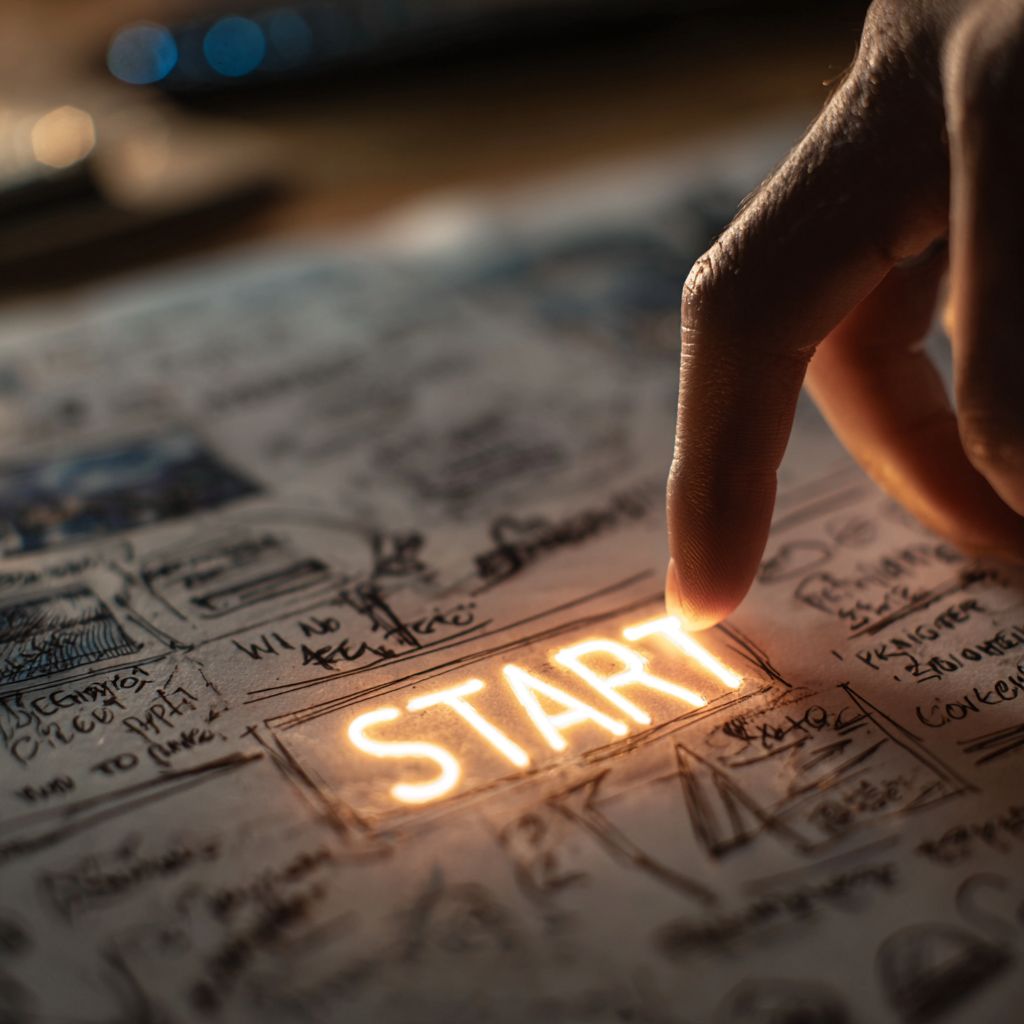
Here’s permission you might not know you needed: you don’t have to start well. You just have to start.
Write that messy first draft. It doesn’t need to be Shakespeare—it needs to exist.
Post that video without a perfect lighting setup. Your message matters more than your production value.
Launch that service before your website is perfect. Your first customers will tell you what really matters anyway.
Send that email even though you don’t have a complete funnel mapped out. Connection beats perfection every time.
The wealthy mindset we talked about in Part 1 isn’t just about avoiding perfectionism—it’s about embracing imperfect action. Speed doesn’t kill quality; overthinking does.
Every successful business, every meaningful relationship, every personal breakthrough started ugly. They started small. They started before they were ready.
But they started.
The Real Question You Need to Ask Yourself
So let me ask you something, and I want you to really think about this:
What’s one thing you know enough about right now to take action?
Not to master. Not to become an expert in. Just to take one meaningful step forward.
What are you pretending to still be “learning” that you could actually be doing? What course are you taking that’s really just a sophisticated form of procrastination? What information are you gathering that you already have enough of to begin?
Here’s another one: What’s one uncomfortable move you can make today?
Uncomfortable because it matters. Uncomfortable because it’s real. Uncomfortable because it moves you from consumer to creator, from student to practitioner, from someone who knows things to someone who does things.
Your Future Self Is Waiting
I’ve learned that done is better than perfect, but more importantly, done is better than planned.
Progress—real progress—isn’t found in another article, another course, or another strategy session. It’s found in the messy middle of actually doing something with what you already know.
Execution really is the shortcut. While others are still deciding which path to take, you’re already learning which direction leads where. While they’re perfecting their strategy, you’re discovering what actually works.
Your future self—the one with the results you want, the life you’re dreaming about, the success you’re working toward—isn’t waiting for you to know more.
They’re waiting for you to do more with what you already know.
So what’s it going to be? Another day of preparation, or the day you finally start?
The choice is yours. But choose quickly—because every day you spend planning is a day someone else spends building.
If your brain feels stuck in thinking mode, here’s something that helped me shift into action:
🎧 Try the Billionaire Brain Wave Audio Here →
Today, just start.
 Small shifts,
Leave a comment